0
What's identical (checked, ruled out)
Before the differences: the two builds share a large, near-parallel
feature set. These were verified the same in both, so they are not where the
divergence lives.
fixed timestep · both 1/120 s accumulator
imageSmoothing · both ON
scene machine · title→play→dead→win, both
coyote time · both
jump buffer · both
variable jump height · both
double-jump gated by pickup · both
AABB axis-separated collision · both
camera lerp + room clamp · both
i-frame blink · both
knockback on hit · both
screen shake · both
damage flash · both
fade transitions · both
squash & stretch · both
grounding shadow · both
vignette · both
parallax background · both
ambient dust motes · both
HUD hearts + ability slot · both
animated gate hint · both
animated exit portal · both
pickup halo + bob · both
chroma-key + despill + auto-trim pipeline · both
procedural sprite fallbacks · both
e2e debug hook on window · both
A
Architecture at a glance
What came out, the module graphs, and where each model's file-edits
actually landed. Counts verified from source and the build logs (the earlier version of
this block had eyeballed numbers — particles are 16/9 not 22/12, and Opus has more draw
methods, not fewer — corrected here).
module graphs
Fable · 7 files · 1332 LOC
one fat core + separate audio
main.ts 57L
boot · canvas · fixed-step loop
↓
game.ts 783L
Player + Enemy + Game all in one file — physics, camera, draw, gate, HUD
↓ imports ↓
particles.ts 126L
16 emit calls · circles
sfx.ts 71LAUDIO ✓
WebAudio, 7 sounds
assets.ts 210L
idle + run sprites
input.ts 44L
keys
level.ts 41L
room geometry (flat consts)
Opus · 9 files · 1525 LOC
more modules, entities split out
main.ts 36L
boot (leaner)
↓
game.ts 648L
loop, 13 render/draw methods, gate, HUD, screens
↓ depends on ↓
entities.ts 349L
Player + Enemy pulled into their own module (idle-only sprite, no run pose)
config.ts 42L
extracted constants
util.ts 29L
aabb · clamp · approach
particles.ts 136L
9 emit calls · squares
assets.ts 142L
idle sprite only
level.ts 59L AUDIO ✗
typed Level interface · no sfx module exists anywhere
where the edits landed — most-edited files (verified counts)
▮ Fable▮ Opus
game logic
test / QA harness
level / content
juice (particles)
config / shell
Verified side-facts: visual QA was comparable (Fable 16 image-reads / 12 playwright runs ·
Opus 14 / 9). Narration volume was not — Fable 2,313 chars across 9 text blocks, Opus
9,994 across 46 (4×). Opus's single most-edited file was its test
(
game.spec.ts, 6 edits); Fable's was its game
(game.ts, 9 edits).
1
Coordinate space & resolution
The single most important fact for reading everything below: the two
games run in different-size pixel worlds. Every constant in §2 lives inside one of
these spaces, so raw number-vs-number comparisons are not apples-to-apples.
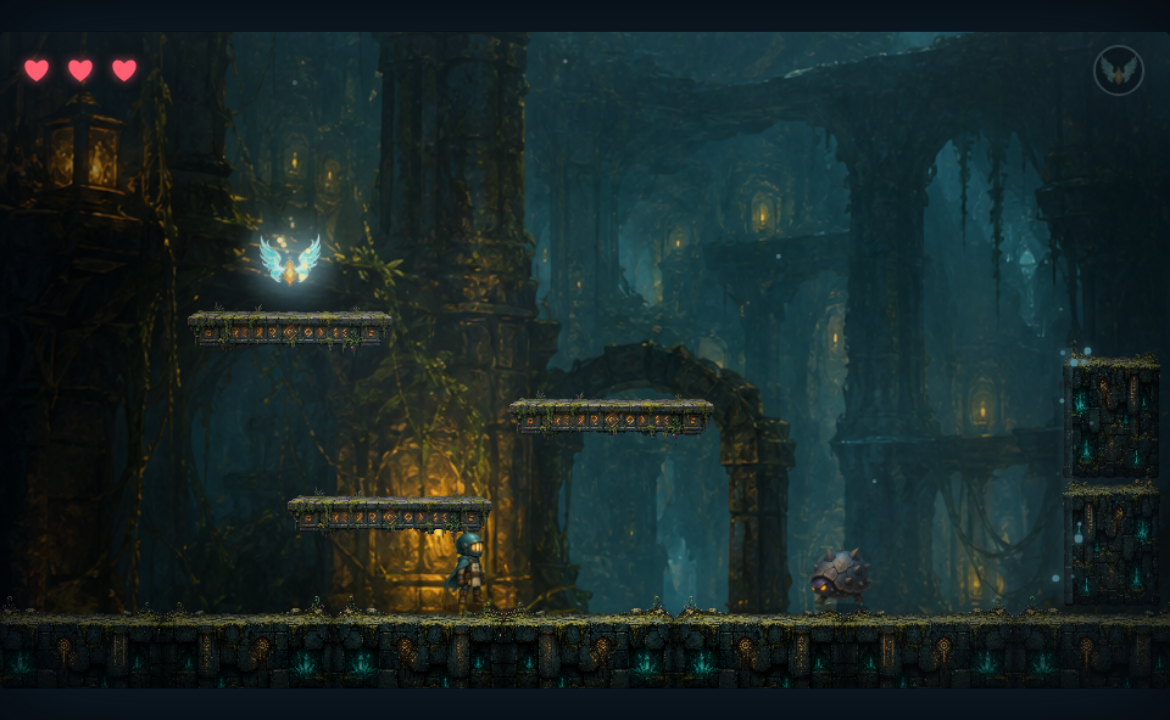
Fable · Lumen Vale
- internal canvas 960 × 540
- room width 1440 (1.5× viewport)
- ground line at y = 470
- pixel area 518,400 px
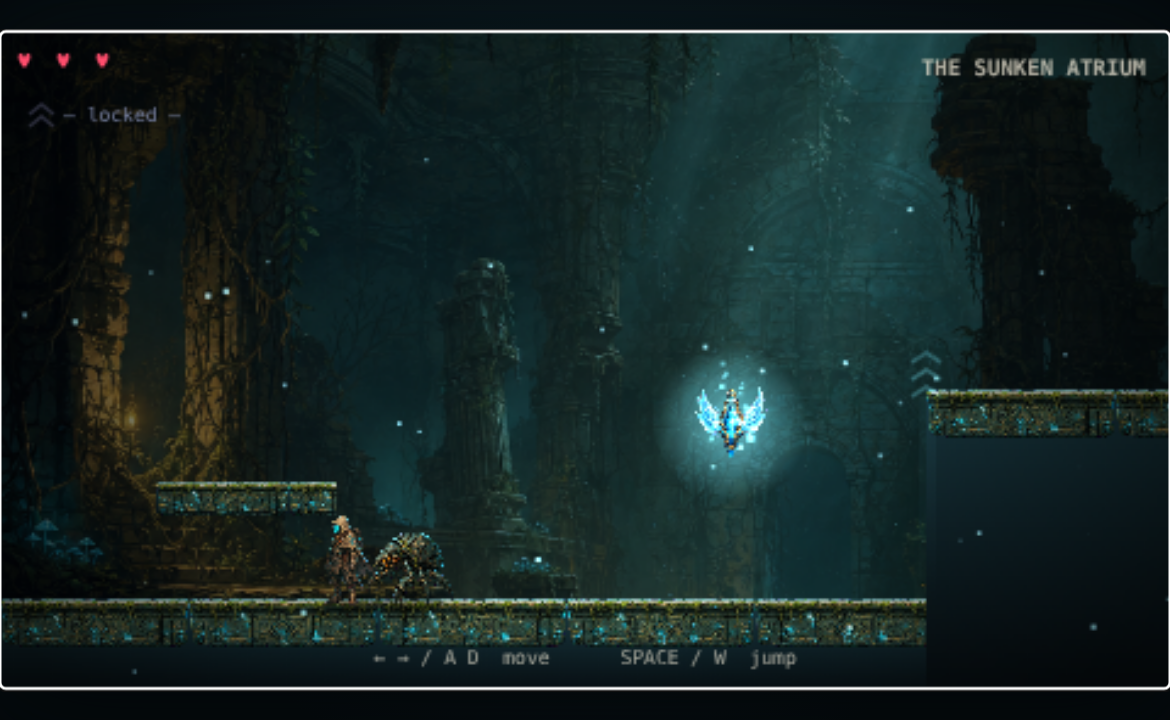
Opus · Sunken Atrium
- internal canvas 480 × 270
- room width 720 (1.5× viewport)
- low floor y = 236 · plateau y = 150
- pixel area 129,600 px (¼ of Fable)
2
Physics constants
Raw values as written, then a normalized column that removes the
resolution gap (Opus distances ×2 into Fable's 960-wide space, or expressed as a
fraction of each game's own screen). Read the normalized column for feel.
| constant | Fable | Opus | normalized / note |
|---|---|---|---|
| GRAVITY | 2200 | 1000 | Opus ×2 ≈ 2000 in Fable-space |
| MOVE_SPEED | 340 | 132 | Opus ×2 = 264 in Fable-space |
| ACCEL (ground) | 3000 | 1400 | Opus ×2 = 2800 |
| ACCEL (air) | 2200 | 900 | Opus ×2 = 1800 |
| JUMP impulse | 760 | 340 | Opus ×2 = 680 |
| DOUBLE-JUMP impulse | 800 | 330 | see note ▼ |
| MAX_FALL | 950 | 540 | Opus ×2 = 1080 |
| COYOTE time | 0.10s | 0.08s | same units (seconds) |
| JUMP_BUFFER | 0.12s | 0.10s | same units (seconds) |
| var-jump clip (release) | vy→−220 | vy→−120 | Opus ×2 = −240 |
| cross-room walk time | 4.2s | 5.5s | room width ÷ move speed |
| jump rise (% screen H) | ≈24% | ≈21% | single-jump apex ÷ view height |
Fable — two facts in the numbers
- double > single: 800 vs 760 — air jump is +5% stronger than the ground jump.
- comments cite level geometry — the jump constant is annotated against the gate's actual pixel height:
JUMP_V = 760; // max rise ≈131px → cannot clear the 210px gate
DOUBLE_JUMP_V = 800; // chained near apex ≈276px → clears the gate with grace
Opus — two facts in the numbers
- double < single: 330 vs 340 — air jump is −3% weaker than the ground jump.
- comments are generic — constants annotated by role, not by level measurement:
JUMP_VELOCITY = -340; // first jump impulse
DOUBLE_JUMP_VELOCITY = -330; // air jump impulse
3
Player animation
Both apply procedural squash/stretch, facing flip and a run-bob. The
difference is whether there are drawn animation frames underneath that.
Fable · 2 sprite sheets
- player-idle.png + player-run.png
- frame-swaps idle⇄run while moving, every ~0.11s; uses run sheet whenever airborne
- + procedural squash on land, vy-based air-stretch, run-bob sin(t·11)
- contact shadow only near floor (y > GROUND−60)
Opus · 1 sprite sheet
- player-idle.png only — no run sheet
- animation is fully procedural: facing mirror, runPhase bob, squash/stretch
- squash tuned per event: jump 0.8/1.28, double 0.7/1.35, land impact-scaled
- death adds a ragdoll rotate(0.4) + sink
4
Audio
A clean binary difference.
Fable · WebAudio synth
- dedicated sfx.ts (71 lines), 10 audio refs
- 7 sounds: jump · doubleJump · land · hurt · die · pickup (3-note arpeggio) · win (C-E-G fanfare)
- per-sound oscillator type, frequency ramp, gain envelope
- unlocks on first key gesture; guarded for headless
Opus · silent
- 0 AudioContext / oscillator references anywhere in src
- no sfx module exists
- the game ships with no sound
5
Enemy
Both are a single horizontal-patrol crawler with no chase AI. Sizing
and detail differ.
Fable
- hitbox 46 × 38
- patrol speed 70
- bob + body lean while walking
- dust puff emitted at each turn
- sprite enemy.png
Opus
- hitbox 26 × 18
- patrol speed 42
- leg-wiggle sin animation
- hitbox inset 3–6px for "fair" contact
- sprite enemy-crawler.png
6
Level topology
Same beat ("can't pass the gate until you find the wings"), built with
different geometry. This is a structural difference, not a count difference.
Fable · flat floor + wall
- one flat floor spanning the whole room
- 3 floating jump-through platforms stepping up-LEFT to a high pickup
- enemy patrols the floor in front of a 210px solid WALL (the gate)
- you jump OVER the wall (needs double-jump), exit portal far right at floor level
- 5 collider records · 4 standable surfaces
Opus · two-tier floor + cliff
- two floor heights: low-left y236 (spawn+enemy+pickup), raised plateau-right y150 (exit)
- the gate is the 86px CLIFF step between them — you climb UP, not over
- 1 small perch ledge on the low side
- 2 invisible side walls to bound the room
- 5 collider records · 3 standable surfaces
7
Terrain rendering
Both build their ground from the slab/ground art; the strategy differs.
Fable · prerendered once
- builds a full static ROOM canvas at startup (
prerenderWorld) - tiles ground.png chunks, mirroring every other tile
- stretches platform.png slabs onto the jump-throughs
- bakes a gradient grounding-shadow below the floor line
- each frame: one
drawImageof the baked canvas
Opus · procedural per frame
- redraws terrain every frame (no prerender)
- each platform = gradient-filled stone rect (#1a3b44→void)
- + clipped platform-slab.png "mossy cap" tiled across the top
- + a 1px lichen highlight line on the top edge
- uses two separate art pieces (ground + platform) collapsed into one (slab)
8
Particle system
Same idea, different primitive and different emitter set.
Fable · particles.ts (126L)
- draws circles (
ctx.arc) - glow via shadowBlur
- 5 emitters: dust · burst · sparkle · ring · generic spawn
- dedicated double-jump ring (12-point expanding circle)
- list uncapped
Opus · particles.ts (136L)
- draws squares (
ctx.fillRect) - glow via additive "lighter" composite
- 4 emitters: dust · burst · sparkle · mote
- ambient mote drift system (atmosphere)
- list capped at 600 (120 for ambient)
9
Glow / lighting technique
How each makes things "shine" — a different canvas API choice that
shows up everywhere (gate seam, pickup halo, exit portal, particles).
Fable
- shadowBlur — 12 uses across the file
- soft blurred bloom around sprites, text, pickup, particles
- 0 uses of additive composite
Opus
- additive globalCompositeOperation="lighter" — 5 uses
- gate seam, pickup halo, exit-portal glow, particles all additive
- + 4 shadowBlur uses (title/death/win text)
10
Generated assets
What art each asked gpt-image-2 to produce.
Fable · 7 sprites
- player-idle · player-run · enemy · pickup · platform · ground · background
- separate ground + platform art
- platform pre-cropped to top 70% (art had a 2nd slab in-frame)
- title screen reuses background.png
Opus · 6 sprites
- player-idle · enemy-crawler · pickup-wings · platform-slab · background · title-art
- no run sheet; one collapsed platform-slab for all terrain
- dedicated title-art.png for the menu
- both chroma pipelines: despill + auto-trim, slightly different thresholds
11
Code structure & strings
File layout and a few literal-string artifacts.
Fable · 7 files · 1332 LOC
- monolithic game.ts (783L) holds Player + Enemy + Game + helpers
- separate sfx.ts; flat exported consts (VIEW/ROOM/SOLIDS…)
- debug hook
window.__game {state, teleport} - HUD font Georgia serif; banner system ("AETHER WINGS")
- title: "LUMEN VALE / a tiny metroidvania", 72px serif
Opus · 9 files · 1525 LOC
- split entities.ts (349L) + config.ts + util.ts + typed level.ts
- no audio file;
Levelas a typed interface - debug hook
window.__metroid {…getters, startGame} - HUD font ui-monospace; room-name + controls-hint timer + ability chip
- title: "SUNKEN ATRIUM", 40px mono; subtitle literally reads "built with Fable"
12
From the build logs — two specific "why"s
Pulled from the stream-json build logs (tool calls + the model's own
narration) for each run. Facts, with the verbatim lines that source them.
Q1 · why no run sprite?
The decision was made in the asset manifest — a planning artifact
written before any game code — not in the renderer and not during QA.
Fable · planned 2 poses
gen-sprites.tslists player-idle and player-run- run prompt: "mid-stride running pose facing right, cape trailing, one leg forward one back, leaning into the run"
- the words run-cycle / walk-cycle / sprite-sheet / animation appear 19× in its log
Opus · planned 1 pose
gen-sprites.mjslists 6 sprites, player-idle only ("standing idle facing right")- hero framed from the start as "chroma-keyed, mirrored + squash/stretch by code"
- those same animation words appear 0× in its entire log — the option was never raised, not raised-and-rejected
Q2 · why the simpler level?
Both did comparable visual QA (Fable 16 image-reads / 12 playwright runs;
Opus 14 / 9). The difference is what each scoped the level as and what its edits
optimized toward.
Fable · built it, barely narrated it
- total narration: 2,313 chars / 9 blocks
- shipped a 3-step vertical climb of jump-through platforms on the first pass
- tuned the jump arc against measured geometry (code comment: "max rise ≈131px → cannot clear the 210px gate")
- one design line in the whole log: "got the whole vertical on the first sprite batch"
Opus · scoped it as a mechanic demo
- total narration: 9,994 chars / 46 blocks (4× Fable)
- scoped the room as "one screen… with a high plateau the player can only mount via double-jump" — one mechanic to show
- its level edit optimized for test determinism, verbatim: "a cleaner design: move the enemy's patrol away from the pickup so the player can stand under the wings and jump straight up to grab them" → traversal got simpler
- spent QA effort on its own test harness (found "keyboard.press releases instantly, so every jump was getting clipped to a 7px hop") and on confirming gate-blocks / wings-unblock / state: win
Two observations (for you to weigh, not conclusions): (1) the run-sprite gap lived in
a checklist, not in skill — an asset manifest that mandated "idle + run for any
walking character" would close it deterministically. (2) Opus's level bent toward whatever
its success signal was — a green, deterministic e2e — so the layout simplified to make
the grab repeatable. The verification target shaped the artifact.